
What Tree Removal Costs in Oakland County (2026 Guide)
Updated September 7, 2026 · Written by Rob Burgund, ISA Certified Arborist MI-4857A
- ISA Certified Arborist MI-4857A
- Working in Oakland County since 2013
- Licensed and insured
- 5.0 stars from 16 Google reviews

Written by Rob Burgund
ISA Certified Arborist · MI-4857A
These are the ranges Rob works from on estimates across Oakland County. He has been quoting tree work here in person since 2013. More about Rob and Tree Pros, or verify the certification in ISA’s public directory.
Those are working ranges, not a quote. Two trees of identical height on the same street can be a thousand dollars apart depending on what sits underneath them.
This page explains what moves the number, so you can read any estimate you receive, ours or a competitor’s, and know what you are actually paying for.
Tree removal cost by size
| Tree size | Typical height | Typical cost | What that usually includes |
|---|---|---|---|
| Small | Under 30 ft | $300 to $600 | Takedown, trunk cut into rounds, brush hauled away |
| Medium | 30 to 60 ft | $600 to $1,400 | Rigging where needed, full site cleanup |
| Large | 60 to 80 ft | $1,200 to $2,500 | Technical rigging, a crew of three or more |
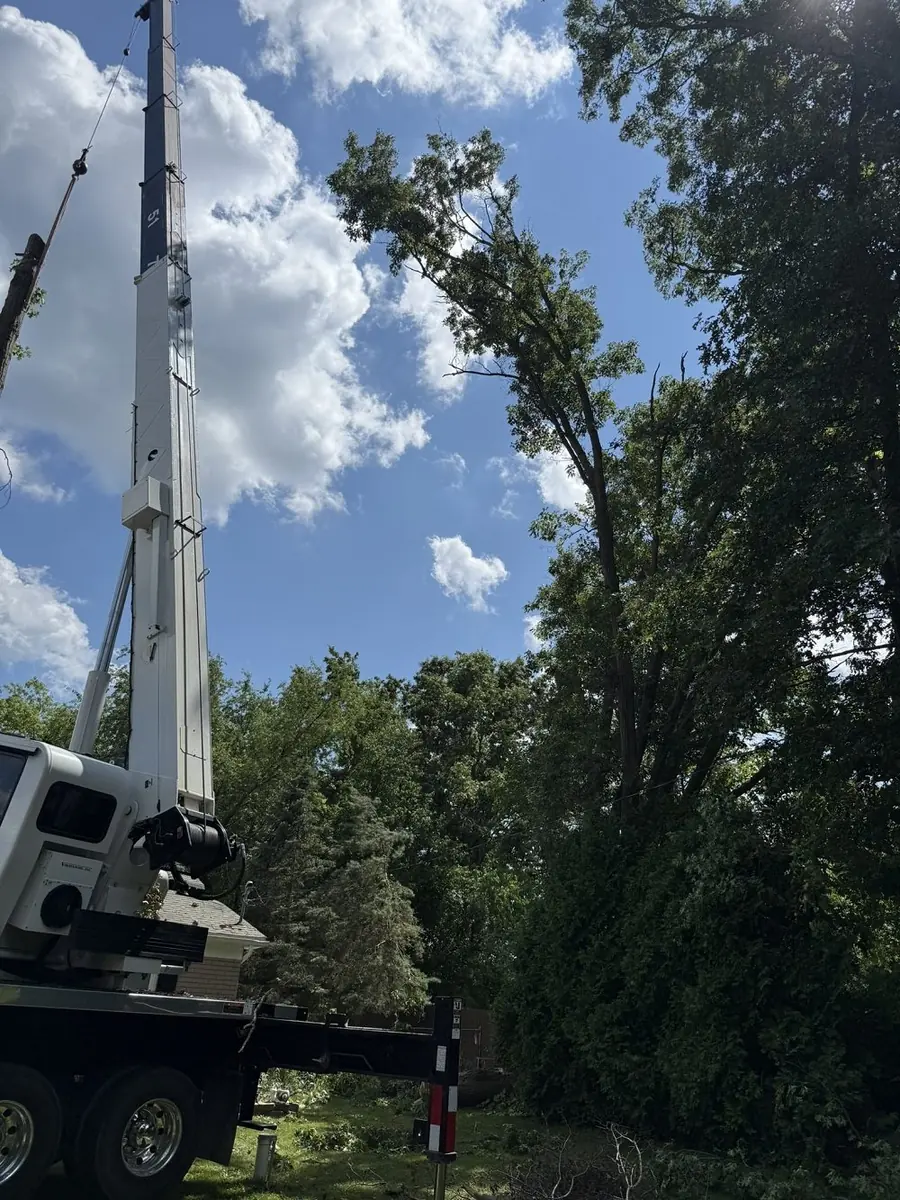
| Very large | Over 80 ft | $2,000 to $4,000+ | Frequently crane-assisted |
Michigan sits a bit below the national average for tree work, but Oakland County runs at or slightly above the state figure. That is not a zip-code premium. The work here is harder.
Established neighborhoods like Bloomfield Hills, Birmingham and Franklin are full of big mature oaks and maples on tight lots, often within striking distance of a roof or a pool or a neighbor’s fence. In Royal Oak, the lots are so narrow that a crane parked in the street is often the only way to get a big tree out.
A tree that cannot simply be felled has to come apart in pieces, each one roped and lowered. That takes time and skill, and that is what you are paying for.
What the related services cost
| Service | Typical cost | Notes |
|---|---|---|
| Stump grinding | $125 per foot | By stump diameter at its widest point. Cheaper booked with the removal, because it is one trip |
| Full stump and root excavation | $400 to $1,000+ | For replanting or hardscaping in the same spot |
| Crane-assisted removal | From $3,500 | For trees too large, too close or too decayed to climb |
| Emergency or storm response | 8-hour minimum | Billed on an eight-hour minimum, based on the equipment the job needs |
| Pruning, mature shade tree | $400 to $900 | To the ANSI A300 standard |
| Pruning, small ornamental | $200 to $450 | |
| Tree risk assessment | $399 | Usually credited toward the work if you proceed |
| Root flare excavation | $250 to $600 | Corrects buried collars and girdling roots |
The six things that actually move the price
1. Access
The biggest factor of all, and the one homeowners least expect.
If a truck can park next to the tree, the job is dramatically cheaper. If every piece has to be carried out through a gate by hand, it is not. When machines cannot reach, a climber spends hours doing what equipment would do in one.
2. What sits underneath
A tree standing in open space is the cheapest kind to remove. One cut and it is on the ground.
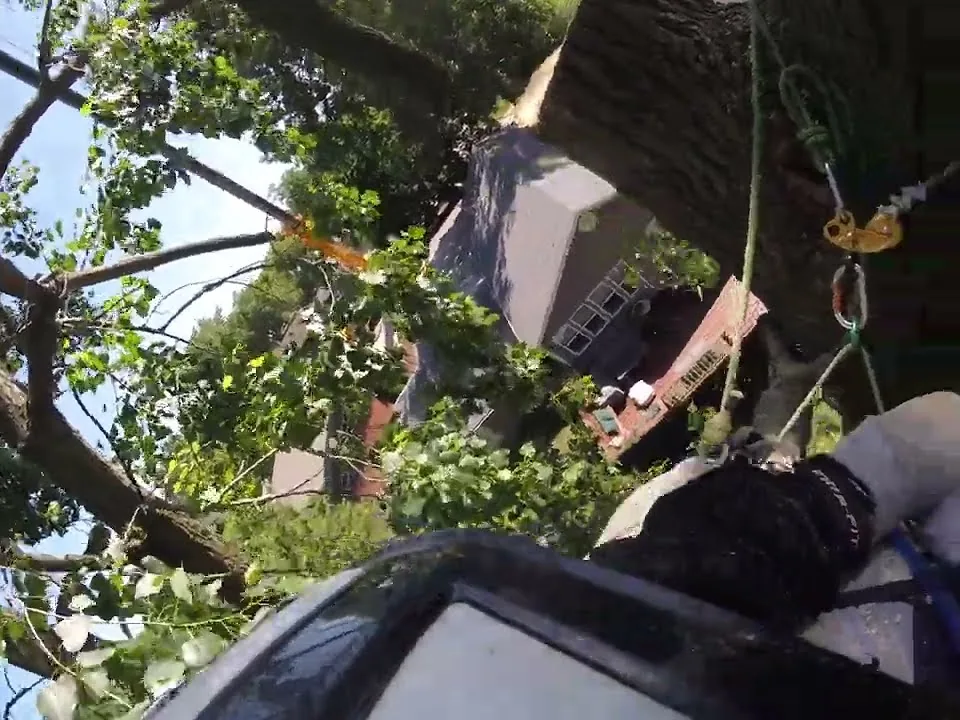
A tree hanging over a roof or a pool or a power line has to come down in small pieces, each one roped and lowered under control. That is where the hours go, and hours are what you are buying.
3. Species and wood density
Oak, hickory and sugar maple are dense, heavy and slow to cut. A poplar or willow or silver maple of the same height is lighter and faster. Two 60-footers can come in at noticeably different prices for this reason alone.
4. Condition, and this one surprises people
A dead or decayed tree usually costs more to remove than a healthy one, not less.
Solid wood holds a climber and holds a rope. Rotten wood does neither, and that is what turns an ordinary job into a crane job.
If you have been putting off removing a dead ash, understand that the price is rising the longer it stands there.
5. Cleanup scope
Hauling every stick away costs more than leaving the logs stacked for firewood. Ask every estimator exactly what is included, because a low number that leaves you with a yard full of wood is not the bargain it looked like.
6. Time of year
Winter is the cheapest season for non-urgent tree work in Michigan. Frozen ground carries heavy equipment without wrecking the lawn, bare canopies come apart faster, and demand drops off after the fall rush.
When removal is not the answer
Not every problem tree needs to come down, and a good arborist will say so before quoting you a removal.
A leaning tree is not automatically a dangerous tree. Plenty of trees have leaned for decades. What matters is whether the lean is new, whether the soil is heaving on the far side, and whether there is decay at the base.
Deadwood in the canopy is usually a pruning job. Mature oaks shed interior branches naturally, and that is maintenance rather than a death sentence.
A weak or cracked fork can often be cabled, meaning supported with a steel cable between the limbs, for a fraction of removal cost.
Storm damage tends to look worse than it is. A tree that lost a big limb can frequently be restored with crown work. Our guide to dying and dangerous trees helps you tell the two apart.
You cannot undo removing a big shade tree. A 60-foot oak took longer to grow than you have been alive, adds real value to the property, and cannot be replaced in your lifetime. Get a second opinion before the saw comes out, ideally from someone whose certification you have looked up.
What is different about Michigan
Permits depend entirely on your city
There is no statewide rule. Troy, Bloomfield Hills and Rochester Hills all have tree ordinances that can require approval before a removal. Birmingham regulates the strip by the street and construction sites. Some neighboring towns have no residential rule at all.
Bloomfield Hills, for instance, lets homeowners on under an acre and a half remove two trees without a permit. Check locally before any work begins, or let us make the call as part of every estimate.
Full permit guide by community →
Oak wilt changes the calendar
Oak wilt is a serious fungal disease in Michigan, and it spreads through fresh wounds during the growing season.
The standard guidance is not to prune or wound oaks between April 15 and July 15, when the beetles that carry it are most active. If storm damage forces a cut inside that window, the wound needs sealing immediately.
Emerald ash borer raised the stakes on waiting
Michigan is where EAB first appeared in North America, and this region has lost most of its untreated ash.
A dead standing ash turns brittle fast, which makes it both more dangerous and more expensive to remove with every season it is left. If yours has been dead more than a year, get it assessed.
Our EAB guide →Dead ash removal cost, in detail →
Will homeowners insurance pay?
If the tree hit something the policy covers, the roof, the garage, a fence, insurance usually pays for the removal, less your deductible.
If it fell in the yard and hit nothing, or you are taking it down because it is dead or in the way, that is on you. Read your policy. We supply the photos and paperwork your adjuster will ask for, and our storm damage page walks through the claim.
What customers say about our pricing
5.0 stars from 16 Google reviews as of October 2026. Every quote below is copied word for word from our Google listing, where you can read all of them.
- “We had an extremely large tree fall the night before the Fourth of July holiday. Rob and his team not only came out right away the morning of the Fourth, but also did an amazing job. Everything was taken care of quickly and he had everything cleaned up as if nothing happened in only a few hours. We always ask for multiple quotes on any house job and his was lower than any other quote we received. 10/10 work and will definitely be calling Tree Pros for all of our tree needs going forward.”
Nick J. · July 2026 · Google review - “They did a great job. Quoted right away. Very reasonable pricing. Came right out and took care of the job. Cleaned up after. Great experience.”
Alex M. · August 2026 · Google review - “Tree Pros did a great job for me and my for my brother. Dropped everything on the ground like pros should and cleaned up well. Good pricing too. I’ll recommend them to anyone.”
Brett R. · May 2026 · Google review
Questions we get about price
How much does it cost to remove a tree in Oakland County?
Most removals here run $600 to $2,500, with the size of the tree setting the starting point and the site setting the rest. A small tree under 30 feet is usually $300 to $600. A medium tree of 30 to 60 feet is $600 to $1,400. A large tree of 60 to 80 feet is $1,200 to $2,500, and anything over 80 feet, which usually needs a crane, runs $2,000 to $4,000 or more. Stump grinding is $125 per foot of stump diameter on top, cheaper if it is done the same day. What pushes a tree toward the top of its range is poor access, a roof or pool or power line underneath it, dense wood like oak or hickory, and dead or decayed wood that cannot hold a climber. What pulls it toward the bottom is open space, a truck parked beside it, and a winter booking. Every one of our quotes is written on site, in writing, with the cleanup scope spelled out. If you are weighing whether to skip the stump to save money, why grinding it after removal pays off lays out the trade-off.
How big of a tree can you remove for around $1,000?
In Oakland County, roughly a 40-to-60-foot tree in a reasonably accessible spot with straightforward rigging. The same budget stretches further on an open lot and nowhere near as far on a tree hanging over the house.
What is the cheapest time of year for tree removal?
Winter. Frozen ground, bare canopies and lower demand make January and February the best-value months in Michigan.
Do I need a permit to cut down a tree on my own property in Michigan?
It depends entirely on your municipality, because there is no state-level rule for private property. Troy, Birmingham, Bloomfield Hills and Rochester Hills are among the Oakland County communities with ordinances that may apply. Several of their neighbors have none. Our permit guide has the rules by community.
How much does it cost to remove a 30-foot tree?
Typically $300 to $600 with good access and nothing underneath it. With stump grinding, plan on roughly $450 to $1,000 all in.
Why are the quotes I got for the same tree so different?
Usually because they are not quoting the same job. Read each estimate for four things. Does it include stump grinding, which is $125 per foot of diameter with us and often a separate line elsewhere? Does all the debris get hauled, or are the logs staying in your yard? Is the crew climbing and rigging the tree down in pieces, or planning to drop it whole and hope? And does the company carry general liability and workers’ compensation insurance, with certificates it will show you? That last one is the expensive gap. An uninsured crew working over your roof is a risk that lands on you if someone gets hurt or something gets crushed, and it is the corner a very low quote most often cuts. Nick J. told us in his review that our quote for a holiday storm removal came in lower than the others he received; Ryan H. wrote that you cannot afford the cheapest guy after a bad experience elsewhere. Both are true. Price the job, not the number.
Does a dead tree cost less to remove?
Usually more. Solid wood holds a climber and holds a rope; rotten wood does neither, so a dead tree often has to come down by crane or from a lift instead of being climbed, and that adds cost. Dead ash is the common case in Oakland County. The wood degrades within a year or two of the tree dying, and the price of removing it rises every season it stands. If yours has been dead more than a year, schedule it now rather than after a storm does.
Tree removal and crane work →Stump grinding cost →Permit rules by community →Storm damage and insurance →All tree care guides →
Get an accurate number for your tree
Nobody can price a tree honestly over the phone. Free on-site estimates across Oakland County, in writing.